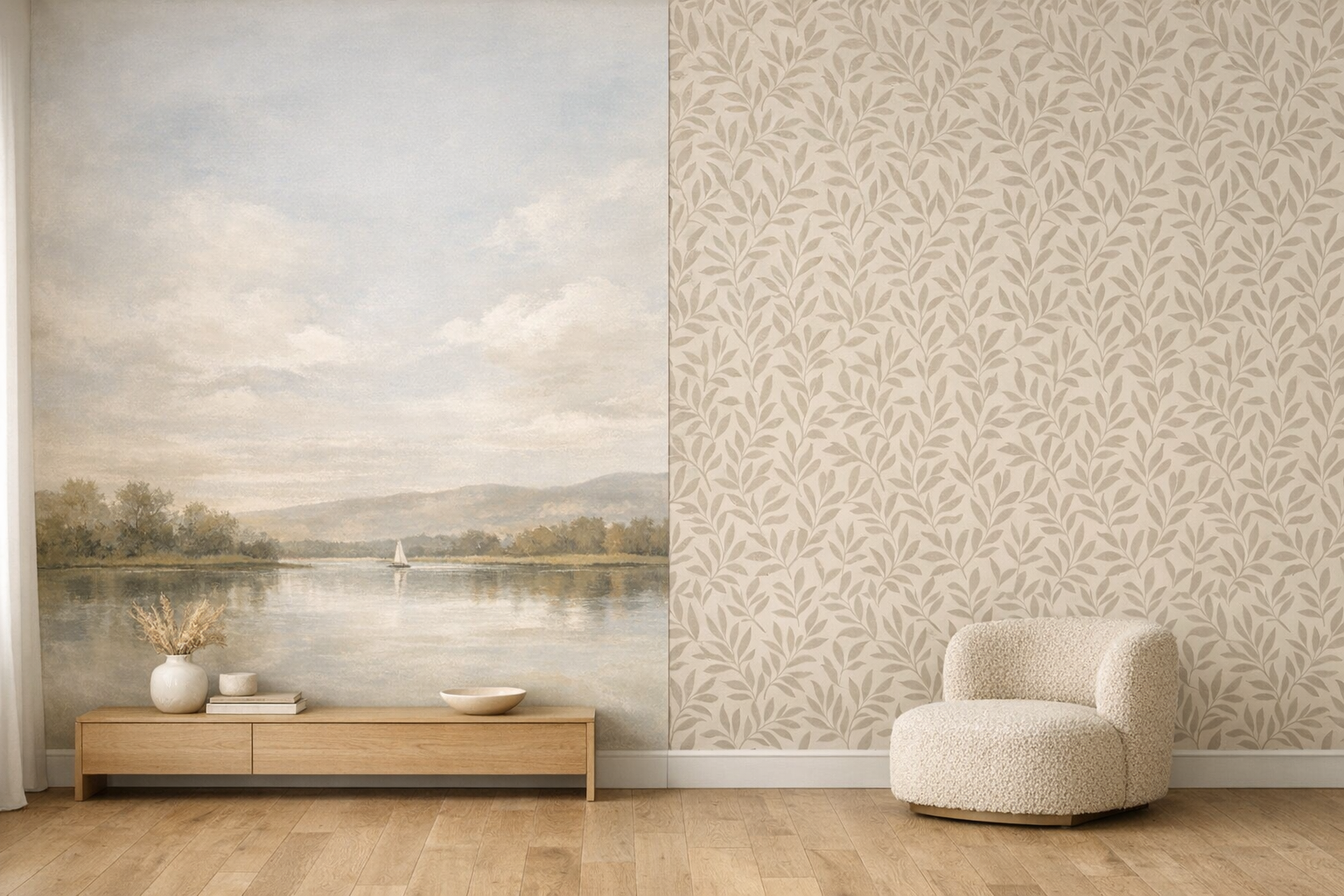
Mural or repeating pattern: which one does your wall need?

Choose a mural when one wall should carry one large picture. Choose a repeating pattern when the design has to run across several walls, around doors and windows or up a staircase. A mural is composed for a single surface, while a pattern looks the same wherever you cut it.

What actually differs

A mural is one image printed to the size of your wall. It has a composition, with a focal point, a top and a bottom, and you choose which part of the image ends up on the wall. You see it as a whole, the way you see a painting.

A repeating pattern is a motif that repeats across and down the wall. It has no single focal point, and it continues for as long as the wall does. Cut it at a corner or a door frame and the next piece carries on with the same rhythm.

Both are printed to your measurements, so the choice is not about size. Murals are by far the more common choice in our orders, more than nine in ten. The pattern is the less obvious option, but it is the one built for awkward walls.

When a pattern is the better answer +

Choose a pattern when the design needs to cover more than one wall. A mural stretched around a whole room becomes one picture broken by every corner and opening. A pattern turns the room into one continuous surface, which is what you want in a dining room, a small study or a hallway papered from end to end.

A pattern also suits walls with many interruptions. Between doors, windows and built-in shelving, each remaining section shows the same motif at the same scale, so nothing important is lost.

Staircases are the third case. When you measure for a pattern along stairs, you need to add extra height to allow for the repeat, and our customer service can tell you the repeat of the design you have chosen. With that allowance, the repeat stays continuous all the way up the stairs.

When a mural is the better answer +

Choose a mural for a single wall that people see as a whole, such as the wall behind a bed or a sofa. A mural can hold a scene with depth or one large subject, which a repeating motif cannot.

Vintage Peonies and Vintage Peonies Pattern show the same subject in both formats. The mural places large ink-drawn peonies rising from the base and sides of the wall, against a weathered dove-gray background, which makes it a composition for one focal wall. Vintage Peonies Pattern spreads beige blossoms and leafy branches evenly across a deep, dark ground. It looks just as good on four walls of a dining room as on one.

“
A pattern turns the room into one continuous surface.

The sample tells you different things

The two also behave differently when you order a sample. A sample of a repeating pattern shows the pattern at its actual size, so you can judge the scale of the motif directly against your wall. A mural sample shows the whole image scaled down. It shows you the colors and the paper, but not how large a flower or a tree will be on your wall. For that, enter your wall's measurements in the preview on the product page.