
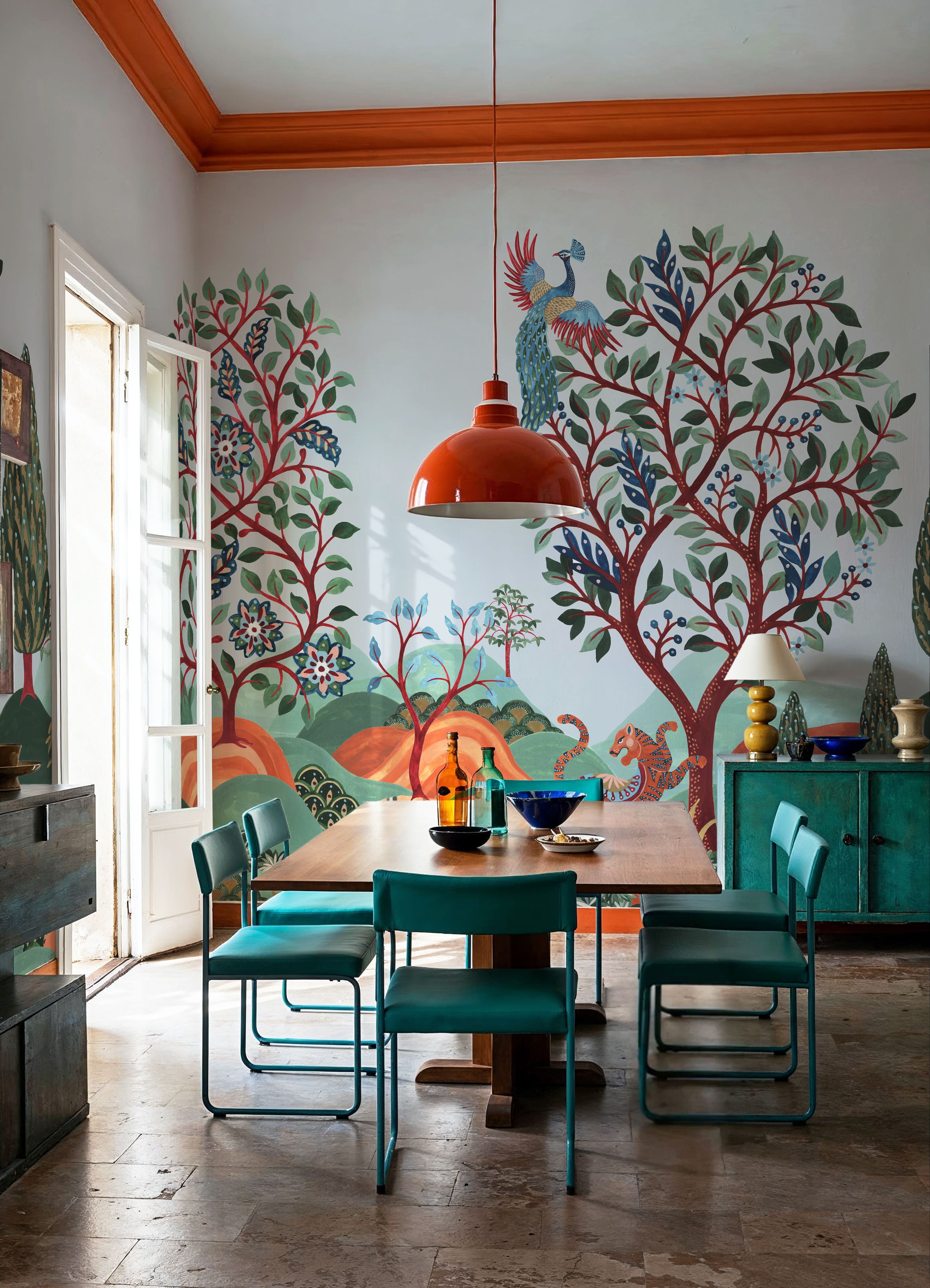
When living and dining areas share a wall, wallpaper needs a clear place to start and stop. Use a corner, doorway, or column as the boundary, or choose between a full-wall design and a framed panel when the surface is uninterrupted.
One wall behind the dining table may be enough
To give the dining area its own character, start with the wall behind the table. If corners or doorways frame it, the wallpaper has a natural stopping point. It can bring the dining area together without covering the living area, too.
Look at the wall from a seat at the table and from the sofa. A low sideboard leaves plenty of the design visible, while a tall display cabinet can cover much of the image. Choose the composition for what will show above and beside the furniture.
Flourish the Flow is one of our most ordered abstract designs. Its green and blue color areas and painted leaf shapes give you several parts of the image to work with. We would give it an uninterrupted wall behind a dining area where it can also be seen from the living room.
An uninterrupted wall needs a clear ending
If the wall runs all the way from the sofa to the dining table, covering the full length is often the simplest approach. Both areas get the same background, and you won't need to find a stopping point in the middle of a flat surface.
If you want wallpaper only behind the sofa, a framed wallpaper panel is another option. Mark out the proposed width with painter's tape and check how the panel relates to the sofa. Thin molding around the wallpaper gives it a clear edge.
Leave some space on both sides of the furniture if you can. You'll see more of the design, and its position will depend less on exactly where the sofa sits.