
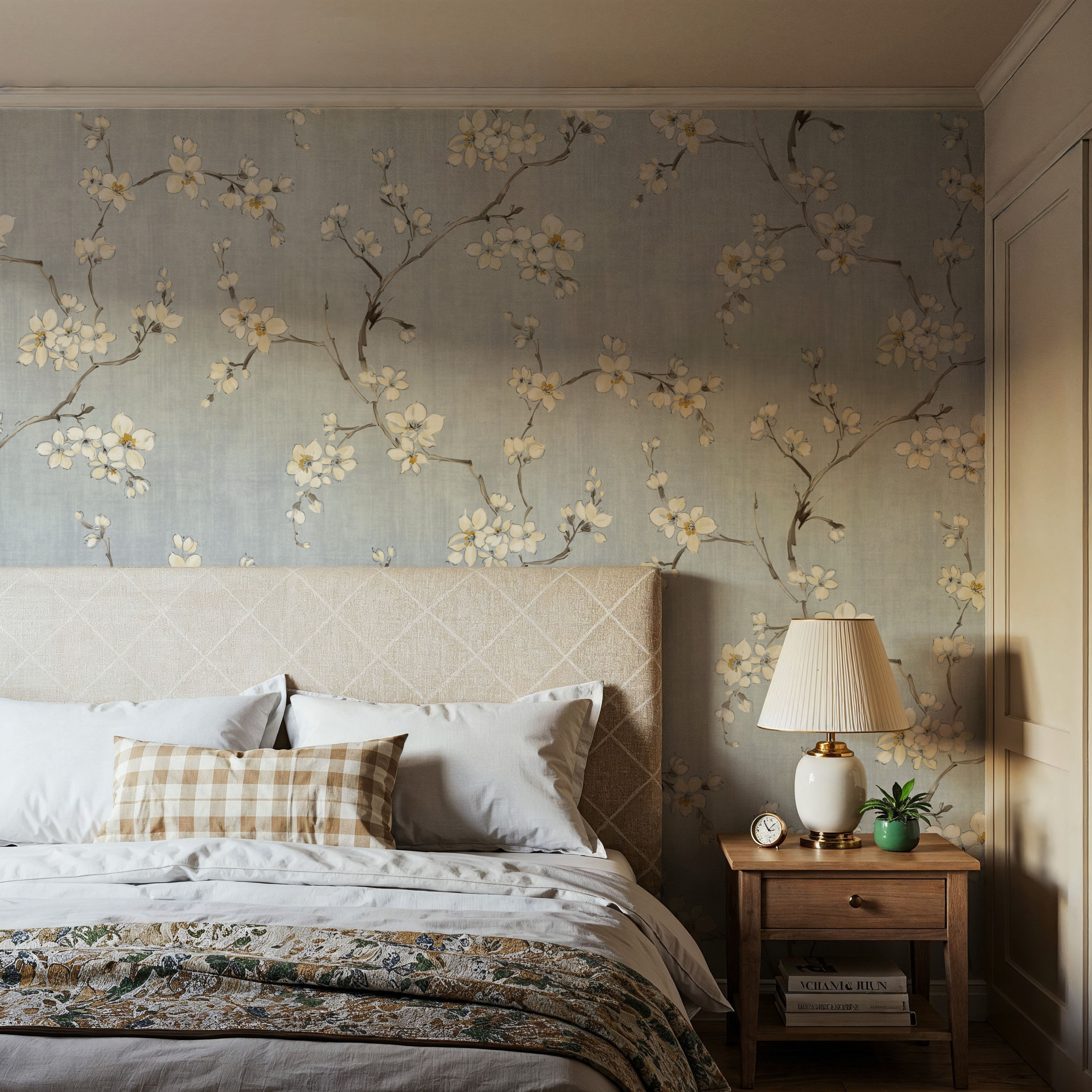
A panel of wallpaper behind the bed works like a headboard that reaches much further than any headboard could. It frames the bed, gives the bedroom a focal point and uses far less paper than a full wall. Because our wallpaper is printed to the exact size you order, the panel can be any width and height you like. What remains is to get the proportions right.
Panel or full wall?
A full accent wall is the obvious choice when the bed wall is narrow, or when the design is a landscape that needs the whole width to make sense. A panel is the better answer when the bed wall is wide and the bed only fills part of it, when a window or a door breaks up the wall, or when you want a statement without wrapping the whole room in it.
A panel also sets the bed apart in a room that has to do more than one job. In a bedroom with a desk or a wardrobe wall, it marks where the sleeping part of the room begins.
How wide
Size the panel from the bed. Make it wider than the bed itself, so it does not look as if the paper ran short. A good rule is the width of the bed plus 15 to 30 cm on each side. For a 160 cm bed, that gives a panel of between 190 and 220 cm.
For a bigger frame, take the panel out to the far edges of the bedside tables, so the lamps and tables sit inside it. Centre the panel on the bed. If the bed is off-centre on the wall, the panel follows the bed.
How high
There are three good options. A panel from floor to ceiling is the cleanest and works in almost any room, and in a bedroom with a low ceiling it makes the room feel taller. A panel that stops partway up the wall looks deliberate if it lines up with something already there, such as the top of the window frames or the doors, and it suits a room with a high ceiling.
The third option is the most dramatic. Take the panel up the wall and continue it across the ceiling above the bed, like a canopy. Our paste-the-wall papers can go on a ceiling as long as the surface is completely smooth, and you will want a second pair of hands. Peel & Stick is not meant for ceilings. If the design should continue from the wall onto the ceiling, contact our customer support before you order.
Hanging and finishing the edges
A panel has edges that a full wall hides in its corners, so they need the most care. Measure the width and height of the panel, and add 5 to 10 cm so you have room to trim. Mark the outline on the wall with a level and a pencil, apply paste right up to the lines and wipe off anything that strays outside them with a damp sponge. That is one of the advantages of pasting the wall instead of the paper. You control exactly where the wallpaper goes.
Trim the edges with a sharp knife and a straight edge for a crisp line. On a painted wall, run masking tape along the outside of the outline before you paste, so the knife cuts into the tape and leaves the paint untouched. For a more finished look, frame the panel with a thin wooden moulding painted in a colour taken from the wallpaper, or paint a narrow border around it.
The third option is the most dramatic. Take the panel up the wall and continue it across the ceiling above the bed, like a canopy.
Choosing the design
With a mural, think about what the headboard and pillows will hide. Use the preview to move the design until the part you love sits above the headboard line. Kyoto Grace, Fog places its blossom canopy high, so the trees stay visible above the bed. Pastoral Toile, Royal Blue, a blue and white woodland toile, gives the bed a classic frame. Floral Gaze, Dark Teal, with roses and peonies on dark teal, makes a dark, dramatic backdrop, and Magnolia Season is a lighter, repeating alternative in soft powder blue.