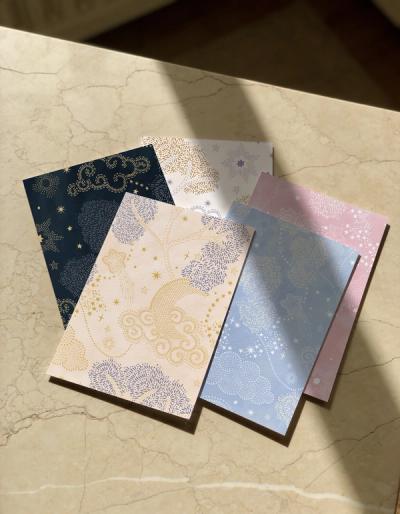
Some wallpapers get sampled far more than others before they go on the wall, and some are mostly bought straight from the screen. A year of orders shows a clear split. Surface effects and repeating patterns make up a far larger share of samples than of purchases, while cities, maps and playful themes are the designs people are most likely to buy on sight. The difference comes down to what a screen can and cannot show you.
Surface effects top the sampling list
Linen and textile looks are sampled four times as often as their share of purchases would suggest. Plaster, stone and metal effects are sampled two to two and a half times as often. The pattern has been the same two years running.
It makes sense. A surface effect has no subject to fall in love with. What you are buying is tone and texture, and those are exactly what a screen flattens. A warm plaster can turn pinkish under evening lamps, and a grey stone can look almost blue beside a cool floor. Aged Texture, a rustic plaster in warm browns, is our most sampled plaster design, and Mottled Linen Effect, Beige is our most sampled linen look.
Most surface effects are murals, so the sample shows a reduced version of the whole design. Use it to judge tone and feel, and use the preview at your wall's measurements to judge the size of the veins or brushstrokes.
Repeating patterns get tried before they are trusted
Repeating patterns are sampled more than twice as often as their share of purchases. With a pattern, the real question is scale. A motif that looks delicate on screen can feel busy across four walls, or the other way round.
A pattern sample shows the design at its actual size, which makes it the most useful sample there is. Tape it to the wall, step back to the doorway and see whether the repeat reads as a soft texture or as a busy picture. Magnolia Season, a soft powder blue magnolia pattern, is our most sampled pattern.
Classic prints and line designs sit in between
Classic prints such as chintz are sampled about one and a half times as often as their share of purchases, and line-based geometric designs about twice as often. Both depend on details that are easy to misjudge on screen. In a classic print it is the exact shade of the background. In a geometric design it is the weight of the line, which decides whether the wall feels crisp or busy. Vintage Peonies and Fresco Home are the most sampled designs in their groups.