
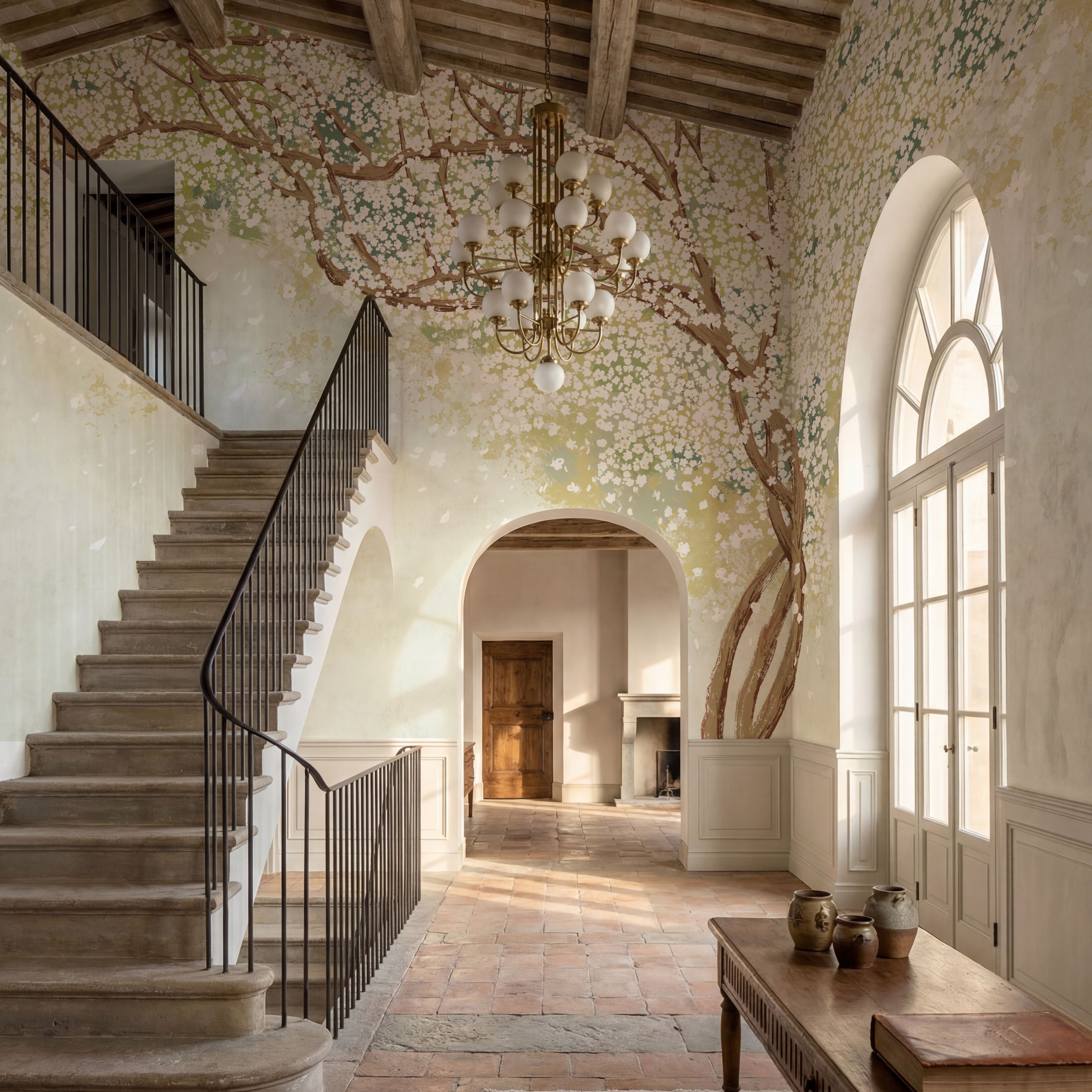
In a Victorian terraced house in Britain, doorways, panelling and stairs can divide the hallway into small wall sections. Decide whether a repeating pattern should connect the hallway and stairs or a wallpaper mural should have a place of its own on the landing.
A repeating pattern can follow the hallway
For walls broken up by doors and the stairs, we recommend starting with a repeating pattern. The design appears in several places as you move through the house, even when each section of wall is quite small.
Fucus Seaweed, French Blue is one of our most ordered classic designs. Blue and blue-grey plant forms flow across a light background. We would use it when you want a botanical pattern to follow the entrance and stairs without needing space for one large image.
A wallpaper sample is a small printed piece of wallpaper you can order to compare the colours and pattern with your home's woodwork before choosing. For Fucus Seaweed, it shows the pattern at its actual size. Hold it against one of the narrow wall sections beside a door and check how it looks from the front entrance. That is where you will first see how the wallpaper sits with the woodwork.
If you have panelling, choose for the wall above it
A dado rail, the horizontal moulding that can divide a wall into lower and upper sections, gives the wallpaper a clear stopping point. If there is panelling below it, you can start the wallpaper above and keep the panelling colour as part of the room's palette.
Look at how much pattern will show between the rail and the ceiling. A repeating design works well in this kind of band. If you want a wallpaper mural, preview the proportions of that particular area to make sure the details you like are included.
Follow the rail's existing line when assessing the wallpaper area. If it continues up the stairs, the shape of the wall section changes. Look at the whole area before choosing a composition.