
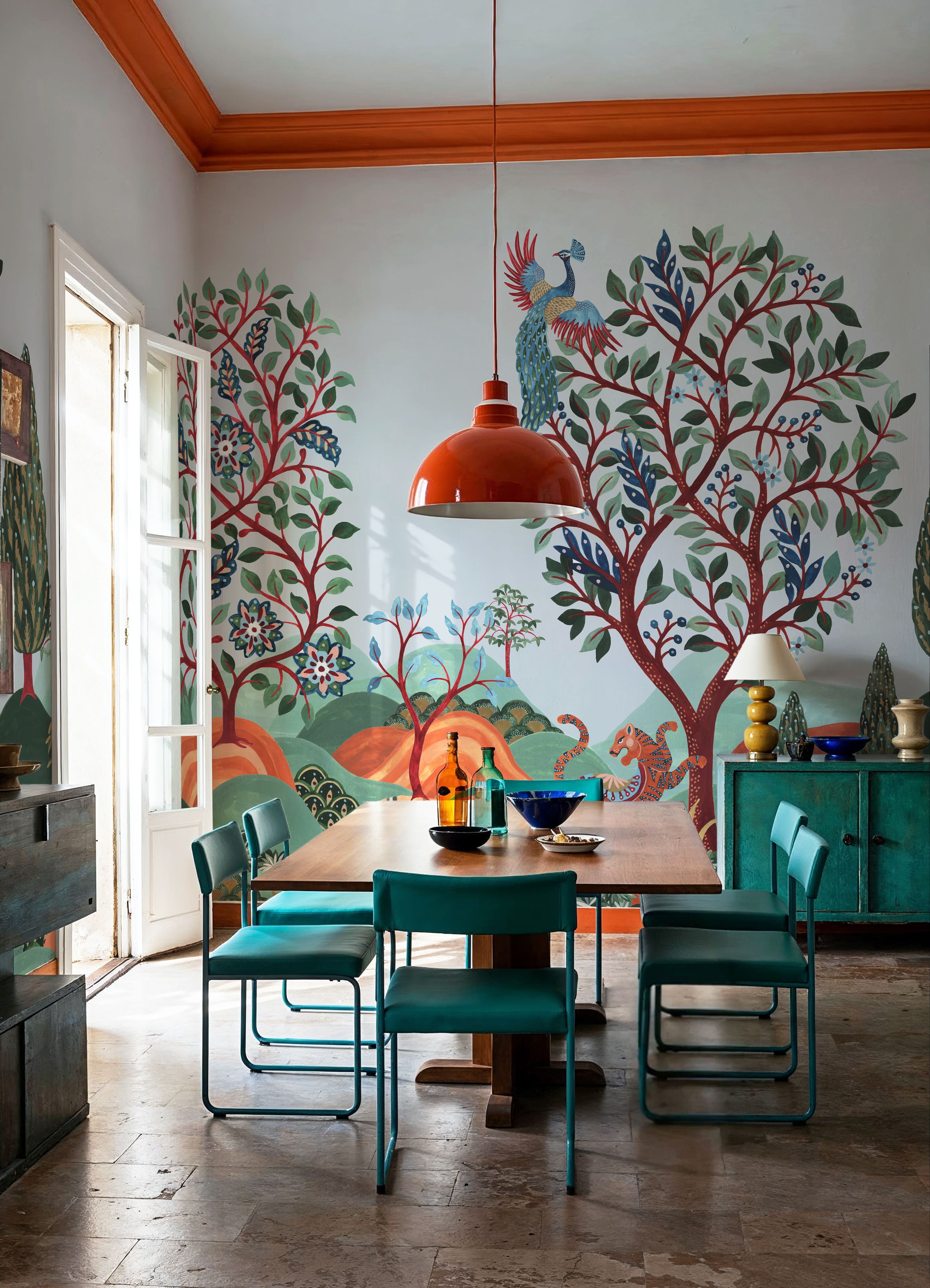
In a Swedish turn-of-the-century flat, the space between door frames, mouldings and a tiled stove determines how much wallpaper you see. Choose a repeating pattern for several smaller wall sections or a wallpaper mural for a clear wall with room for the composition.
Let the room's existing divisions guide you
First, look at where the visible wall starts and stops. If you have tall skirting boards, wall panelling or moulding below the ceiling, there is already a frame to work with. The design will fill the clear space between them.
A repeating pattern can follow several of these wall sections without each one needing to show a complete image. It is a good starting point in a room with several doors and windows. We would give a landscape or a larger floral composition a wall with more uninterrupted space.
If you are wallpapering above panelling, judge the design for that shorter section of wall. A branch that looks good in a floor-to-ceiling image may sit very differently when the wallpaper starts higher up.
A floral pattern can work across several wall sections
Magnolia Season is one of our most ordered classic designs. White flowers and winding branches repeat against a light blue background. We would choose it to carry the wallpaper around a whole room while leaving prominent door frames and mouldings room to show.
You can order a wallpaper sample, a small printed piece of wallpaper, to see how the colours and pattern work with the woodwork at home. For Magnolia Season, it shows the pattern at its actual size. Hold it against the wall beside a door frame. You will see how the size of the branches sits alongside the width of the woodwork. Look up close and from the adjoining room, especially if the doors usually stay open.
On tall walls, you also need to see the pattern across a larger area. The product image shows how the flowers repeat, while the sample helps you judge scale and colour. Use the two together to make your choice.