Classic prints are back. In our orders they grew by two thirds in a year. But toile, chinoiserie and chintz come from three very different traditions, and each suits a different room and a different mood. Toile tells a quiet story in one colour, chinoiserie paints an imagined garden of birds and branches, and chintz fills the wall with flowers. This is how to tell them apart and choose.
Toile: one colour, one story
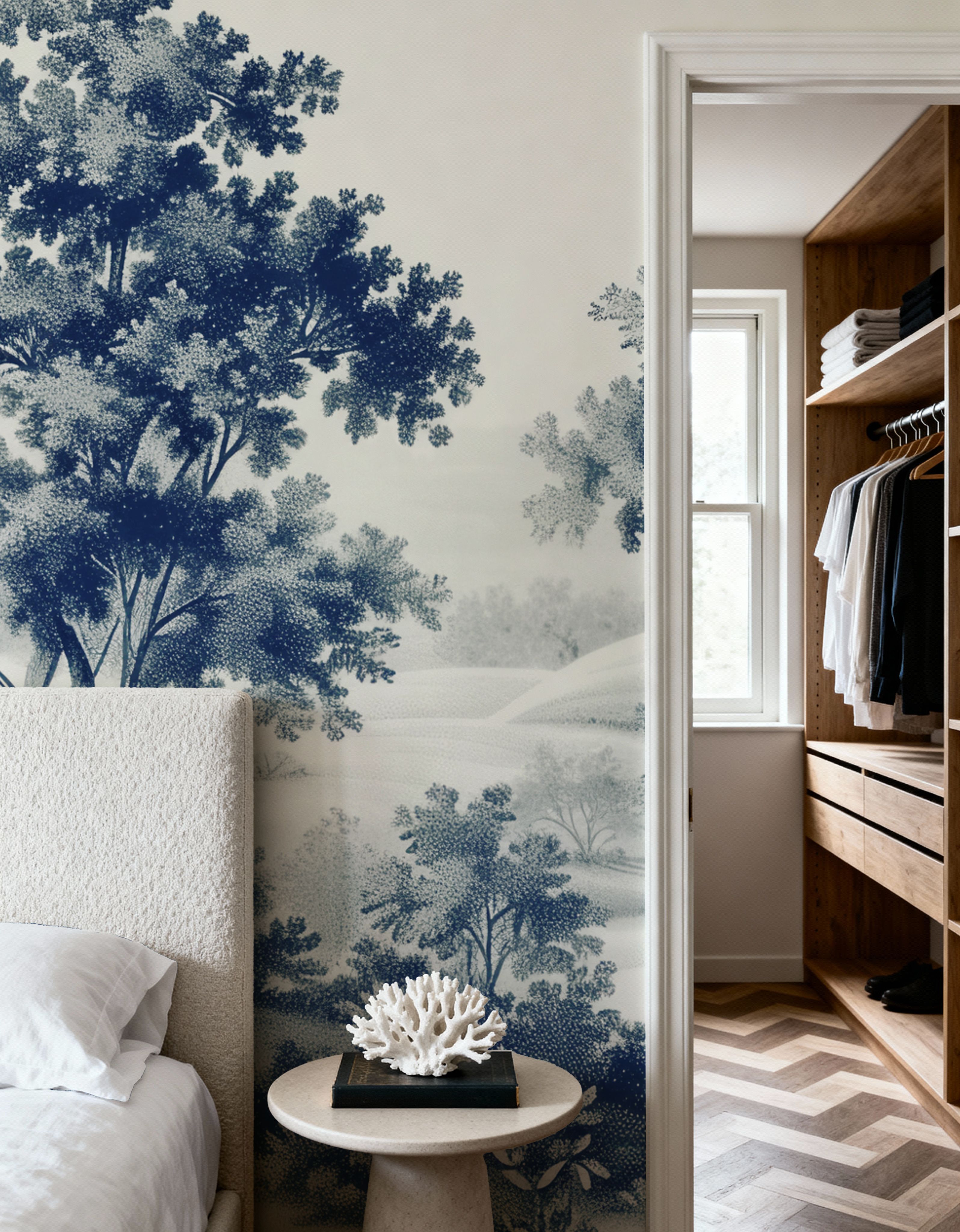
Toile de Jouy takes its name from Jouy-en-Josas near Versailles, where Christophe-Philippe Oberkampf began printing cotton in 1760. It is best known for pastoral or figurative scenes printed in a single colour, often red or blue, on an off-white ground.
That single colour is what makes toile so easy to live with. From across the room it reads as a soft texture. Up close it rewards you with detail, trees, rivers, figures and animals. Pastoral Toile, Royal Blue is the classic version, a blue and white woodland scene. Toile Hills, Beige moves the idea into warm sepia with a mountain landscape, and Patinated Linen Toile de Jouy, Olive sets nature scenes and wildlife on a background that looks like aged linen.
Toile is the most versatile of the three. It works floor to ceiling in a bedroom or a small hallway, and it pairs well with checks, stripes and plain linen. In our orders it more than tripled in a year, from a small base, so it is still a confident choice rather than a common one.
Chinoiserie: an imagined East in birds and branches
Chinoiserie is a European style that flourished in the 18th century, when European makers imitated and imagined the art of China, Japan and other parts of Asia. Its world is made of exotic birds, flowering branches, pagodas and fantastical landscapes, usually spread loosely across the wall with plenty of space around them.
That openness is what sets chinoiserie apart. It is the most decorative of the three, but it rarely feels crowded. Kyoto Grace, Fog, a Japanese-inspired scene of trees and birds on a soft grey ground, shows the light side. Peacock and Peony Chinoiserie Teal shows the opposite, with peonies and branches on a deep teal background that suits a dining room or an evening room. Magnolia Season, a magnolia pattern in soft powder blue, brings the same flowering branches into a repeat.
Chinoiserie is still rare in our orders, but it belongs to the same family as the classic prints that are growing. It is the one we would keep an eye on.
Chintz: the whole garden on one wall
Chintz began as painted and printed cotton from India, and it became hugely popular in England from the late 17th century. Today the word means bold, dense florals, blooms packed so closely that the background almost disappears.
Of the three, chintz is the most romantic and the most generous. Traditional chintz sits on a light ground, but some of the most striking chintz-style wallpapers today use a dark one, which makes the flowers glow. Floral Gaze, Dark Teal fills the wall with roses, peonies and exotic blooms on dark teal. Vintage Peonies sets beige blooms on a dark background, and its grey colourway gives a softer, almost misty version of the same design. Chintz grew by about half in our orders over the past year.